International Student Support
DepartmentsPre-Departure Seminar
Please look at the following before entering the United States. There is valuable information regarding immigration, the start of school and more.
Pre-Departure Seminar
Pre-Departure Seminar
To watch the narrated slide deck, click here.
To view a file of the slide deck click below.
2026-2027 Academic Calendar
What to Bring for Move-In
Before Arriving in the US
Obtaining an I-20 to apply for a visa
You are accepted to Nichols and made a deposit, now what?
The P/DSO will receive all your information from admissions so we can provide, to you, an I-20. The I-20 IS NOT your visa, it is your ticket to apply for a visa.
Below is an example of an I-20 with each part labeled.
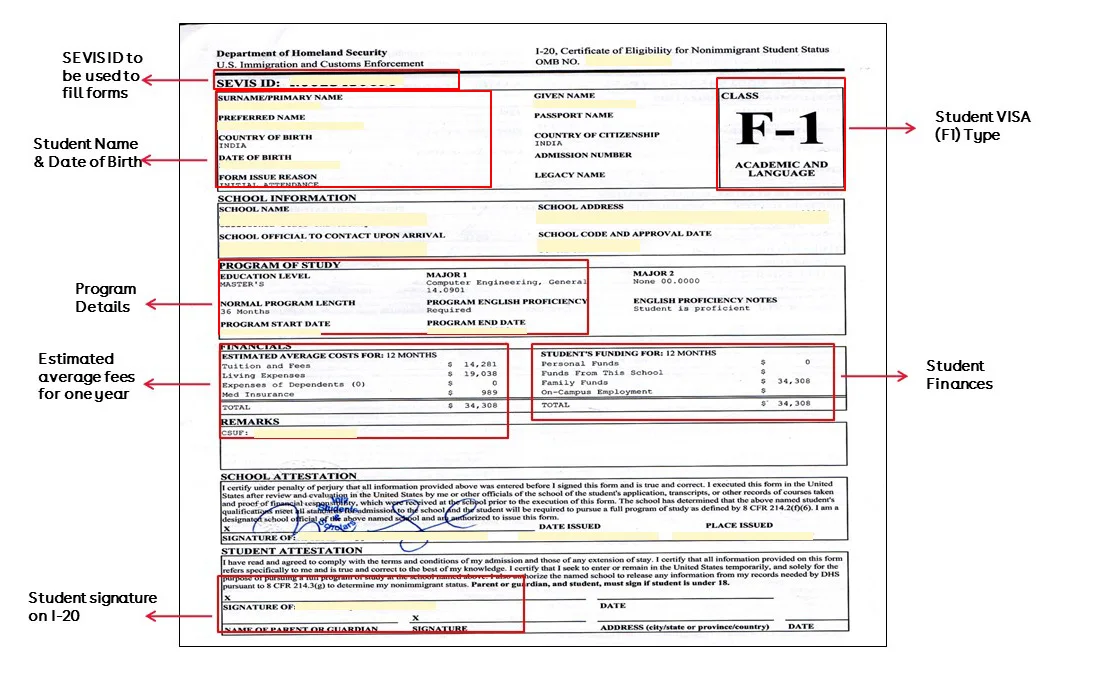
On the back of your I-20, you will see a space for the following: Employment authorizations, Change of Status/Cap-Gap Extension, Authorized Reduced Course Load, Current Session Dates and Travel Endorsement. NONE of this will be filled out at this point. In the future, we may/may not utilize some of those sections on the back.
-
You will also need to fill out the online Non-immigrant Visa Application, Form DS-160 and print to bring with you to the interview.
-
Upload a photo while completing the online form DS-160.
-
Schedule your interview at a U.S. Embassy in the country you live. Here is a link to the embassy’s in your country with wait times.
-
Prepare for your visa interview. Here’s a video to help you understand what you might expect.
-
Pay the non-refundable fee
I'm a Canadian, Do I need a Visa?
Woohoo! You do not need a visa if you are Canadian!
Once you receive your I-20 from the International Programs office, please make sure of the following:
- The P/DSO signed the front page
- You sign the front page
On the back of your I-20, you will see a space for the following: Employment authorizations, Change of Status/Cap-Gap Extension, Authorized Reduced Course Load, Current Session Dates and Travel Endorsement. NONE of this will be filled out at this point. In the future, we may/may not utilize some of those sections on the back.
Health Insurance
It is highly recommended that you keep the University Health Plan from Nichols College. The state of Massachusetts requires Affordable Care Act (ACA) compliant insurance. While ISO or other insurances may be cheaper, they are only ACA comparable and not compliant. Purchasing comparable insurance may have future tax implications and could result in higher costs overall.
VERY IMPORTANT HEALTH DOCUMENTATION
-
Medical History Form- this is an online form on the BisonCare Health Portal. Be prepared to add information about your own medical history, family medical history, medications, and any health problems.
-
TB Risk Screen Questionnaire- this is an online form on the BisonCare Health Portal.
-
ALL required immunizations
-
Tdap within 10 years (tetanus, diphtheria, pertussis)
-
Documented immunity to Varicella: Series of 2 vaccinations OR positive titer OR physician certified history of chicken pox.
-
Documented immunity to measles, mumps, rubella: series of 2 MMR vaccinations OR positive titers for ALL 3 (Measles, Mumps, and Rubella titers)
-
Documented Immunity to Hepatitis B: Series of 3 vaccinations OR positive titer
-
Either a Meningitis A vaccine given AFTER the 16th birthday OR the signed Meningitis Waiver Form
-
-
Physical Exam that is within 1 year from the start of the semester HOWEVER, Athletes’ physicals must be within 6 months. The Physical Exam Form must be completed, signed/dated by the physician and/or stamped with their office information.
-
Physical Exams are required to be within 6 months to meet NCAA standards
-
Negative sickle cell test results
-
Front and Back of the insurance card, in addition to signing an “Insurance & Consent Form” on the BisonCare Health Portal
-
There may be additional consent/safety forms required on the BisonCare Health Portal
- To access the BisonCare Health Portal, you will need your OneLogin from Nichols. If you have trouble with this, please contact IT at: helpdesk@nichols.edu
Link to enroll in University Health Plan
Arriving to Campus
Please contact Student Life at student.life@nichols.edu if you plan or need to arrive early to make arrangements.
Once you arrive, you have 30 days to see your P/DSO and verify your presence on campus. The office will then update your I-20 and print a new one.
Please use the following link to set up an appointment to do this the first few weeks of school.
**NEGLECTING TO CHECK IN WITH P/DSO WITHIN 30 DAYS WILL RESULT IN A CANCELLATION OF YOUR I-20 AND YOUR AUTHORIZATION TO BE IN THE US AS A STUDENT**
Links For Visa Information
Links for Visa Information
Visa Wait Times
Please click the link below to see current visa wait times for your country or city.
Schedule Your Visa Appointment
To schedule an appointment, please use the link above to find your embassy. On the embassy website, you will find information on how to schedule an appointment. Each country’s embassy does this a little differently. If you need help, please reach out.
Apply for your DS-160
Where do I go for help?
There are many departments on campus that can help you succeed and answer all your questions. Please see departments below for a short description of what you may contact them for and how to contact them.
Public Safety
This is 24/7 assistance with emergencies and non-emergencies.
Parking decals, access to campus facilities if you happen to forget your key or ID, and emergency response is just a few things they can assist with.
Contact:
publicsafety@nichols.edu
508-213-2298
Located on the lower level of Daniels Auditorium
Student Financial Services
For help with billing, health insurance, payments, scholarships and all things money, please contact Student Financial Services.
Contact:
SFS@nichols.edu
508-213-2288
3rd Floor, Conrad Hall, Offices 311-315.
Registrar
Transcripts, course registration, Enrollment verification (for your home country if you are provided tuition assistance from your government), withdrawal, course request and anything having to do with enrollment and courses.
Contact:
registrar@nichols.edu
508-213-2290
Academic Building Room 223
Academic Advising
Advising helps with choosing courses, majors, course selection and potential careers. If you need accommodations, you can also discuss this with the advising team.
Contact:
advising@nichols.edu
Advising Suite 217-221
Residence Life
Residence halls, policies and living on campus can be found in Residence Life.
Contact:
508-213-2092
reslife@nichols.edu
FELS Student Center, 3rd Floor
Student Life
Student life has a wealth of knowledge, resources and information for all things about being a Bison on campus.
Contact:
508-213-2480
student.life@nichols.edu
FELS Student Center, 3rd floor
Campus Map
International Student Handbook
This handbook is a quick guide for how to stay in status and manage your time in the United States. What you cannot find in the guide, you can find on this site.
PowerPoint on Basics For F1 Students
Important information on maintaining your F1 student status.
All you need to know to study in the states
As an international student, there are many rules and regulations you must follow to stay in F1 student status. Find helpful info here about common challenges international students face. Got questions? Stop by and chat with your PDSO, Kristen Malinowski-Paine, in ACES (Main Floor, Library, Office 306). You can also visit your DSO, Maureen Butler, Academic Affairs, Conant, 204. We’re here and happy to help you!
Maintaining F1 Status
F-1 Students
In order to maintain F1 status, you must do the following:
- Enroll in the required number of credit hours each semester, which is 12 credits.
- Ensure your I-20 form has a current travel signature and reflects any changes to your program or status.
- Maintain good academic standing
- Report any addresses changes promptly to your P/DSO
- Follow work authorization rules
- Obtain proper authorization for off-campus work
- Curricular Practical Training (CPT) is an internship related to yoru major.
- Optional Practical Training (OPT) is working post graduation in a field related to your major.
- Communicate with your P/DSO about any concerns or changes impacting your F1 status.
- Understand the “five-month rule”
- Generally, you can temporarily leave the US for up to five months without jeopardizing your F1 status. Speak to your P/DSO if this might pertain to your specific situation.
On-Campus Employment
In general, on-campus employment for international students means that you are working:
-
On Nichols campus;
-
For a Nichols property or department and are on payroll such as The Bison Den, Golf Course or Nichols Consulting Group;
-
Are working for a student facing third party vendor such as American Dining or Barnes and Noble.
If these conditions are not met–for example, you would be working on campus but a professor or organization other than NIchols College would be paying you, please speak with the Director of International Programs or your P/DSO.
As an F-1 student, you can work up to 20 hours per week on campus without separate employment authorization, but you’ll need to get a social security number.
Guidelines and Restrictions to On-Campus Employment
-
When you first enter the country in F-1 status, your first day of employment should be no earlier than 30 days before classes start.
-
While school is in session, you can’t work more than 20 hours per week. During the summer and other breaks, you can work full time.
-
You can’t continue employment after you’ve finished your program of study, unless you have a new I-20 for a new program of study.
-
You can only work at the school that controls your SEVIS record. If you are attending 2 intuitions at the same time, you can only work on the campus that issued your I-20.
-
F-1 students CANNOT work off campus without specific authorization. Please see the Director of International Programs or your P/DSO to your advisor first.
Finding On-Campus Employment
Tips
-
You can search for on-campus jobs through Handshake.
-
Look for the career fair held on campus at the beginning of each semester.
-
Visit Nichols’ Career and Professional Development Center.
-
International students aren’t eligible for Federal Work Study positions.
Obtaining a Social Security Number for On-Campus Employment or CPT/OPT
To Apply For a Social Security Number
You will need a Social Security Number (SSN) to work on campus.
Before applying for a Social Security Number (SSN), you must first have either:
- An official on-campus job offer or
- An internship offer letter
Applying for your SSN and Making an Appointment
Step 1: Schedule Your Appointment
You must make an appointment with a Social Security Administration (SSA) office. You may choose any office located in:
- Massachusetts
- Connecticut
- Rhode Island
Click here to schedule your appointment.
Step 2: Save Your Appointment Information
After scheduling your appointment, you MUST either:
- Take a screenshot of your confirmation page, OR
- Write down the following information:
- Appointment date and time
- Office location
- Confirmation number
- Click here to make an appointment online
⚠️Important: Once you close the appointment window, you will NOT be able to retrieve this information again.⚠️
You must bring your confirmation number to your appointment. If you do not have it, the SSA office will deny your appointment, and you will need to restart the process.
Step 3: Prepare Your Documents
Before attending your appointment, you must prepare your document packet.
You are required to meet with your P/DSO first to receive the remaining documents needed for your SSN application.
Do not attend your appointment until you have received the remaining documents needed for your P/DSO.
You will need to obtain a letter from your supervisor on campus. Current Supervisor Job Letter Offer for SSN Appt.
Need an SSN for a Non-Employment Reason?
If you need a Social Security Number for a reason other than employment–such as:
- Applying for a driver’s license
- Signing an apartment lease
- Opening a bank account
we can provide you with a support letter to apply for an SSN that does not authorize employment.
Please contact your P/DSO for additional information or make an appointment with your PDSO here.
Documents to apply for a Social Security Number
Instructions for Applying for a Social Security Number
Curricular Practical Training (CPT) or an Internship
Curricular Practical Training (CPT) allows F-1 students to participate in an off-campus internship or training experience that is directly related to their major field of study.
CPT may be:
- Paid or unpaid
- For academic credit or not for academic credit
Please review all CPT rules and requirements carefully before accepting or beginning any internship opportunity.
⚠️ Important Reminder About CPT Authorization⚠️
CPT authorization must be approved and added to your I-20 BEFORE you begin any internship or off-campus training experience.
This means:
- You must speak with your P/DSO first
- Your internship start and end dates must appear on your updated I-20
- You must receive the new CPT-authorized I-20 before your first day of work or training
CPT cannot be approved retroactively or backdated after you begin working.
If you start an internship before receiving CPT authorization on your I-20, you will be violating your F-1 status, and this may have serious immigration consequences.
When in doubt, always ask your P/DSO before accepting or starting any off-campus opportunity.
CPT Special Eligibility Considerations
-
Students can only be authorized for CPT during their degree program: F-1 students interested in working in the US after graduation may apply for post-completion Optional Practical Training (OPT).
-
Exception to one academic year requirement: The one academic year waiting period can be waived for students enrolled in a graduate program that requires a practicum during their first year. Or, transfers that have completed one academic year in the same degree level. Therefore, if you are an undergraduate who transferred after one year in undergraduate studies in the US, you are eligible for CPT.
-
Leave of Absences and Other SEVIS Terminations: Students who have re-entered the US using a new SEVIS record after a previous record was terminated/completed will need to complete one academic year of full-time study under their new SEVIS record before becoming eligible for CPT. This rule applies to a student who was given an authorized early withdrawal for a leave of absence (gap semester/year) and returned to the US with a new SEVIS record.
-
Unpaid Internships: Financial compensation is not the only indicator of employment in the US. We recommend that students obtain work authorization for any activities with non-Nichols organizations. In the case of unpaid internships, the student should also obtain written verification from the organization’s Human Resources confirming the position does not violate any labor laws.
-
Part-time or Full-time
-
Part-time CPT is 20 hours a week or less
-
Students can participate in part-time CPT when school is in session.
-
If the CPT will take place during your final semester, only part-time CPT is allowed.
-
-
Full-time is 20+ hours a week
-
A student may participate in full-time CPT during the summer or breaks unless the student is in their first or last term.
-
**Any student who is authorized for one full year or more (365+ days) of full-time CPT loses eligibility for OPT at their degree level.**
-
-
Employment Dates: If the CPT eligibility is based on enrollment in a course (option #2), the CPT authorization must fall within the semester dates as listed on the College’s Academic Calendar.
-
There are circumstances when employment dates can fall outside the academic calendar. These instances will be evaluated on a case-by-case basis.
-
Students requesting an exception should be prepared to provide documentation that explains the reason the position must start before the “classes begin” date and/or after the “end of Term” date as listed on the calendar.
-
Documentation may include:
- An offer letter, supplemental offer letter, email from the hiring manager proving the start/end date.
- Official job posting that states the required start and end date for interns accepted into the program
- Other documentation explaining the medical or other extenuating circumstance
- CPT may not overlap semesters.
- Please contact your P/DSO to discuss your situation if you have questions.
-
-
Multiple CPT authorizations with the same employer: For CPTs that are not required by a degree program, students may not receive multiple CPT authorizations for the same experience.
-
In rare cases, a student may be eligible for a second CPT authorization with the same employer, provided that the experience is significantly different from the first CPT authorization. (ex. Student receives a CPT authorization for an internship in marketing with Company A, and then submits a CPT request for a second internship with Company A in the field of Accounting).
-
A student may not receive a second CPT authorization to extend a practical training experience. If a student wishes to gain additional practical training in the same position, the student would need to apply for pre-completion OPT.
Unpaid Internship and CPT
F-1 students engaged in paid internships must have CPT or another form of employment authorization. However, even for unpaid internships, we strongly recommend students to apply for CPT. By obtaining CPT authorization even for unpaid training or internship activities, a student:
-
is able to demonstrate to US immigration authorities that the activities were reviewed and approved by the student’s academic department and the International Programs department, and certified as integral and appropriate to their academic program
-
is given the flexibility to accept compensation or payment or other forms of material benefits that would not otherwise be approvable or allowed without CPT authorization
-
will have reassurance that any activities carried out that could be considered employment under US labor definitions were authorized
**Note that in many cases internship providers will also require students to obtain CPT approval as a condition of participating in the unpaid internship, to demonstrate that the interns are engaged in academic activities rather than employment. **
Unpaid Internships Defined: It is also important to realize that the US Department of Labor has set out several criteria that identify when an internship may be legitimately unpaid. Employers who fail to meet the criteria for unpaid internships may be expected to offer paid employment instead, and the interns may be expected to have appropriate authorization. Because an unpaid internship may actually be employment under Department of Labor guidelines, CPT authorization is strongly recommended for the purposes as well. The main criteria that determine whether an internship may be unpaid include the following factors:
-
The internship, even though it includes actual operations on the facilities of the employer, is similar to training which would be given in an educational environment;
-
The internship experience is for the benefit of the intern;
-
The intern does not displace regular employees, but works under close supervision of existing staff;
-
The employer that provides the training derives no immediate advantage from the activities of the intern; and on occasion its operations may actually be impeded;
-
The intern is not necessarily entitled to a job at the conclusion of the internship; and
-
The employer and the intern understand that the intern is not entitled to wages for the time spent in the internship
If all of the criteria are satisfied then the internship may be considered a legitimate unpaid internship. However, in the event of any uncertainty, then obtaining authorization is recommended.
If you are planning to include an unpaid internship experience as a part of your employment history (i.e., on your resume or CV), then we strongly recommend obtaining a letter from your internship provider that verifies the dates and location of your internship, that your internship was unpaid, and a brief description of the duties and objectives associated with the internship. This information may be useful in the event that you are ever asked to document that the activities were appropriately structured as an unpaid internship.
Impact of CPT on Optional Practical Training (OPT)
Under current US federal government practice, CPT approval has an impact on your OPT ONLY in the rare case that you do one full-year (12 months or more) of FULL-TIME CPT. If this happens, you will lose your eligibility for OPT. Part-time CPT or full-time CPT under 12 months should not have an effect on your OPT eligibility.
CPT Authorization Dates and Extensions
CPT authorization is approved on a term-by-term basis and cannot automatically continue into a new semester or term.
This means:
- Your CPT authorization must match the dates listed on your I-20
- If your internship, practicum, or training experience continues into a new term, you must apply for and receive a new CPT authorization before continuing
Exception for Certain Graduate Students
Graduate students participating in:
- Multi-term internships or practicums, OR
- Research that is an integral part of an approved thesis or dissertation
may be eligible for CPT authorization that extends beyond one term.
However, students approved under this exception must:
- Continue registering for internship or research credits each term, AND
- Maintain full-time enrollment throughout the authorization period
Important: You Must Have an Updated CPT I-20
You cannot begin or continue any CPT opportunity unless you have received an updated Form I-20 showing:
- CPT approval
- Employer information
- Authorized start and end dates
⚠️ Your CPT dates must be active and listed on your I-20 before you begin working.⚠️
CPT Cannot Be Approved Retroactively
The International Center cannot issue retroactive CPT authorization.
This means CPT cannot be:
- Backdated
- Approved after you already started working
- Added to your I-20 after the internship has begun or ended
If you begin CPT before speaking with your P/DSO and receiving CPT authorization on your I-20, your employment is considered unauthorized and may place your F-1 status at risk.
When in doubt, always contact your P/DSO before accepting or beginning any off-campus internship or training opportunity.
CPT in the Final Term/Graduation Semester
You can be authorized to engage in CPT in your final term as long as the following requirements are met:
-
You must still be working toward your degree requirements in your final term.
-
Your CPT experience must either be required or optional training in your major (if the experience is optional, you must do the CPT for internship credit).
-
CPT is limited to part-time (20 hours or less) if taking place during the fall or spring semesters.
-
For certain graduate programs full-time CPT may be permitted; see the section above on Part-time versus Full-time CPT.
-
Pre-completion Optional Practical Training (OPT) versus CPT
Some students who are considering CPT may want to think about pre-completion OPT instead. Like CPT, pre-completion OPT allows for work related to your major. However, there some advantages and disadvantages, depending on each student’s plans. See the table below. While pre-completion OPT requires preparation well in advance, it does not need a job offer to get started and does not require registration for internship credit, which is a typical requirement for most CPT requests.
CPT Application Steps
Step 1: Obtain an offer letter
To qualify for CPT, you must have a job offer from an internship provider. The internship site should provide a letter written on company letterhead that provides the following information:
-
-
Name of the company or internship site
-
Address where your training will take place (internship site address)
-
Supervisor name and contact information
-
Detailed description of internship or job duties
-
Start and end dates of your internship
-
Expected hours per week
-
Salary information, if paid
-
A statement from the employer declaring their support and cooperation to fulfill the curricular purposes of the employment/training
-
Step 2: Meet with your advisor and register through Handshake
Once you have an internship offer, it must be reviewed by an academic advisor or faculty member in your department.
The academic advisor must determine if the training provides an appropriate learning experience in your major. If your department approves of the experience, they will assist you in registering for internship credit. If you are engaging in experiential learning and will not obtain credit, you still need approval from your advisor.
You NEED to register for your experience through Handshake. Please contact CPDC if you are unsure how to do this. cpdc@nichols.edu or stop by the office on the 2nd floor of FELS.
Step 3: Submit CPT request to International Programs Office
You will need to use your Nichols email to complete the form.
Access the form here or scan the QR code below.
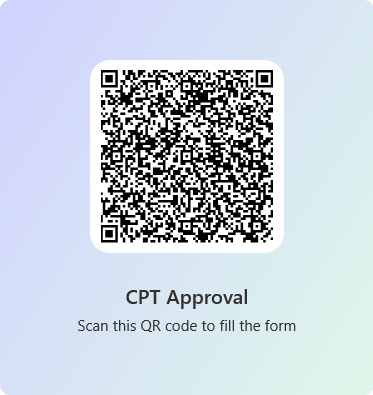
CPT I-20 Registration Form
Please complete this form to register your CPT with International Programs and receive an updated I-20 with CPT endorsement.
Optional Practical Training (OPT)
Optional Practical Training (OPT) is work authorization granted to you post graduation. This allows you to live and work in the states in a position related to your major for one year. Here you will find the rules, regulations and important deadlines to apply for OPT.
What is OPT?
Optional Practical Training (OPT) is meant to give F-1 students practical experience in their major field of study, and students can apply for it either during their program of study or after graduation. OPT generally lasts up to 12 months.
Before you can participate in OPT, you’ll need to get approval from US Citizenship and Immigration Services, which usually takes around 90-100 days, but processing times may vary. Students should plan ahead, attend a workshop in a timely manner, and apply as early as possible.
You do not need to have a job offer when you apply, but you are required to begin working on post-completion OPT within 90 days of the start date on your OPT EAD card in order to maintain valid F-1 status.
When classes are in session, pre-completion OPT can only be part-time (up to 20 hours per week). It can be full-time during the summer and other breaks.
During Post-completion OPT, you must work 20 hours or more per week. You can work with multiple organizations, as long as each position is directly related to your major field of study and cumulatively add up to at least 20 hours per week.
If you are considering an unpaid internship or position, you may do so during the regular post-completion OPT period, but you should get written verification that your position does not violate any local, state, and federal labor laws from an HR representative at your organization. Financial compensation is not the only indicator of employment.
Am I eligible to apply for OPT?
You can apply for OPT if:
-
You currently hold F-1 status.
-
You have finished at least one academic year as a full-time student at a US institution.
-
You have not participated in full-time CPT for 12 months or more at your degree level.
If you re-enter the US using a new SEVIS record after your previous record was terminated, you need to complete another academic year of full-time study before you can apply for OPT.
How do I apply for OPT?
Below is an overview of the steps for applying for OPT. See OPT Frequently Asked Questions for additional details about these steps.
-
Sign up and participate in a virtual OPT workshop.
-
Prepare documents for the I-765. You can access a draft form here.
-
Address in the US.
- To apply for your OPT, use this link. You will need to create a USCIS account first.
You need an OPT endorsed I20 to upload when you apply. You will automatically be denied if you do not have this. You need to see me first for this. I can also help you through the application process.
*The local US Postal Service will not deliver US government mail if they are not completely certain that the individual lives at the address. The address you supply must be a valid address that you will have for at least four months and your name must be on the mailbox. Also note, the USPS will not forward US government mail. If you move subsequent to your filing the application and do not notify the SErvice Center, the card will be returned to the Center by the post office. It is your responsibility to notify the USPS in the event of an address change.
-
Schedule an OPT Review Appointment.
During your meeting, you will be issued a NEW I-20 with OPT requested, which you must have BEFORE filing USCIS petition for work authorization. If you file for OPT without your new I-20 with OPT requested, you will be denied.
OPT Calculator
US Driver's License
Yes, you can obtain a driver’s license while you are a student at Nichols College. If you intend to drive long term while a student, you will be required to obtain a Massachusetts driver’s license.
Converting A Foreign Driver's License
International students who become residents of Massachusetts while studying for a degree are generally expected to obtain a Massachusetts driver’s license.
License Conversion Eligibility
If you currently hold a valid driver’s license from one of the following countries or territories, you may be able to convert your license without taking the written or road test:
- Canada
- Mexico
- South Korea
- Germany
- France
- Taiwan
- Certain U.S. territories
Students from these locations may still need to provide required documentation and complete the application process through the Massachusetts Registry of Motor Vehicles.
If your country is not listed
If your driver’s license is from a country not listed above, you will generally be required to:
- Pass a Massachusetts written learner’s permit test
- Complete a road test
- Meet all RMV documentation requirements
Important Reminder About Residency
Some international visitors may drive in the United States for up to one year using:
- A valid foreign driver’s license
- An International Driving Permit (IDP), if required
However, once you establish residency in Massachusetts while studying for a degree, you are expected to apply for a Massachusetts driver’s license.
Driver's License
Driver’s License and State ID Guide
As of July 2023, eligible residents in Massachusetts can obtain a standard driver’s license or State ID, regardless of immigration status, under the Work and Family Mobility Act.
Please note that this information is provided for general guidance only. It is your responsibility to consult official Massachusetts State RMV information and to abide by all applicable state and federal laws.
International students who have an F-1 or J-1 visa are eligible to apply for a driver’s license at the Registry of Motor Vehicles (RMV), Class D License.
Driver's Education and Learner's Permit
-
Getting a Learner’s Permit
The learner’s permit written test fee covers the cost of processing your application and administering your test. If you fail the test or your permit expires, you will be charged this fee again for another test. You’ll need to study the Driver’s Manual in order to prepare for the written test.
-
Driving Lessons and School
If you don’t know how to drive, you will need to contact a local driving school and arrange to take driving lessons.The closest driving schools to campus are LaPorte’s Driving School and AAA of Worcester.
Massachusetts State ID
A state ID card would provide you with another form of identification rather than relying on your passport.
How to Apply
Begin online at the MA state Apply for a Massachusetts Identification Card (MASS ID) page, which will outline application steps.
Depending on your situation, you may need to go to a Registry of Motor Vehicles location in Massachusetts to complete your application. Locations closest to us are Webster, Southbridge, Auburn and Worcester.
Please note that all services are not necessarily available at all locations. It is important to check with the individual branch ahead of time.
DOCUMENTATION YOU MAY NEED TO APPLY
-
A completed application form
-
Proof of identity (passport, foreign national ID card, etc.)
-
Your social security card (you must have a card; knowing the number will not be enough), OR a social security administration form indicating that your application for a social security number was denied.
-
To request a “Social Security Denial Letter,” visit the Social Security Office in persona and you will be presented a denial letter the same day of your request.
-
-
Proof of Massachusetts residency: To obtain a letter confirming your Massachusetts residency, please email the office at ip@nichols.edu.
-
For REAL ID
-
Your most recent I-94 (to prove your visa status)
-
Your current I-20
-
Your SSN card
-
Helpful Tips
- Always carry your valid license when driving
- Make sure your automobile insurance is active and valid
- Make sure your car is registered with the State of Massachusetts
- Review Massachusetts driving laws carefully, as they may differ from your home country
- Check the RMV website regularly, as requirements and policies may change.
If you need help, ISS can help guide you to the appropriate RMV resources.
Local Driving Schools
If you are interested in learning to drive or obtaining a Massachusetts driver’s license, there are several local driving schools in the Central Massachusetts area that work with teen and adult drivers, including international students.
Some nearby options include:
Alert Driving Academy–Located in Webster and commonly used by local students for driver education, road test preparation, and RMV-sponsored road tests.
Green Light Driving School–Located in Sturbridge and offers driving lessons and driver education services.
CMSC Driving School–One of the larger driving schools in Central Massachusetts with extensive driver training programs and multiple service options.
Common Academic Terms and Phrases in the United States
Common Academic Terms and Phrases in the United States
U.S. colleges and universities often use academic words and phrases that may be unfamiliar to international students. Understanding these terms can help you feel more confident navigating classes, assignments, and campus resources.
Academic Terms You May Hear Often
Syllabus
A document provided by your professor that explains:
- Course expectations
- Assignments
- Grading policies
- Attendance rules
- Important dates
Always read your syllabus carefully at the start of the semester.
Office Hours
Times when professors are available to meet with students outside of class to answer questions or provide support. Attending office hours is encouraged and considered normal in the U.S., especially if you need clarification on subject material.
GPA (Grade Point Average)
A numerical representation of your academic performance. Many scholarships, internships, and immigration benefits may require students to maintain a minimum GPA.
GPA Scale:
A=4.0
B=3.3
C=2.0
D=1.0
F=0.0
Credits/Credit Hours
A system used to measure the value of a course and your progress toward graduation.
Full-time undergraduate students are typically required to maintain a minimum number of credits each semester for F-1 status. Full-time is 12 credits, however, it is often advised to take 15 credits in the event you have to drop a course.
Major
Your primary area of academic study.
Example:
- Business
- Psychology
- Computer Science
Minor
A secondary area of study that requires fewer courses than a major.
Elective
A course you choose based on your interests or degree requirements.
Add/Drop Period
A short period at the beginning of the semester when students may adjust their schedules without academic penalty.
Always speak with your academic advisor and International Student Support team before making schedule changes.
Academic Probation
A status resulting from unsatisfactory academic work; a student on academic probation must improve their academic performance or be dismissed from the university after a specified length of time.
People and Departments
Academic Advisor
A staff or faculty member who helps students:
- Select classes
- Understand degree requirements
- Stay on track for graduation
Registrar
The campus office responsible for:
- Course registration
- Academic records
- Transcripts
- Enrollment Verification
Provost
An academic administrator, the chief academic officer, who oversees academic policies, curriculum development, faculty appointments and research.
Dean
An academic administrator responsible for overseeing a specific school, faculty, or department. At Nichols, we have a Dean of Business and a Dean of Liberal Arts.
Transcript
An official record of your courses, grades, and academic history.
Common Classroom Phrases
Participation
Many U.S. classes include participation as part of your grade. Professors may expect:
- Asking questions
- Joining discussions
- Sharing opinions
- Group collaboration
Group Project
An assignment completed with other students. Communication and teamwork are very important.
Academic Integrity/Honesty
Rules related to honesty in academics.
Examples of violations may include:
- Cheating
- Plagiarism
- Unauthorized AI use
- Copying other student’s work
Always ask your professor if you are unsure what is allowed.
Citation
Giving proper credit when using someone else’s ideas, words, or research.
Common citation styles include:
- APA
- MLA
- Chicago
ACES is a great place to go to have someone look over your papers and check your citations.
Midterm and Final
Major exams or projects completed during or at the end of the semester.
Helpful Academic Tips
- Ask questions early if you are confused
- Check your email and learning platforms regularly
- Visit professors during office hours
- Use tutoring and academic support services
- Do not wait until you are struggling to seek help
ACES, your peer tutoring center located in the library, is an excellent resource. Stop in or make an appointment by emailing aces@nichols.edu
Remember
Academic culture in the United States may feel different at first. Professors generally appreciate students who communicate, participate, and ask for support when needed. Seeking help is viewed as a strength–not a weakness.
Common Immigration Terms & Phrases
Common Immigration Terms & Phrases
Alien Registration Number
Identification number assigned to an immigrant for US government purposes. In certain cases, at the discretion of the USCIS, registration numbers may be assigned to non-immigrant students and exchange visitors. However, most F-1 students in the US do not have “A” numbers.
Certificate of Eligibility (Form I-20)
Forms I-20 or DS-2019 are issued by a recognized US educational, vocational, or non-academic institution that accepts a foreign student for full-time study. Their sponsor, or the US educational institution they will be attending, issues the DS-2019 to exchange visitors. The I-20 and DS-2019 forms are not visas; they are used to show that you are eligible to apply for the non-immigrant student visa.
Change of Status
Change from one non-immigrant classification to another. Change of status requires an application and USCIS approval.
Filing Taxes in the United States
Filing Taxes in the United States
Filing Taxes in the United States
Every international student must file taxes whether you earned money through work or did not earn money.
The tax deadline is April 15, 2026 and all materials must be postmarked by that date.
Please see below and read the section that pertains to your situation.
I Did Not Work
International students in the U.S. on an F-1 visa who did not work or earn any U.S. income are still required to file IRS From 8843 (Statement for Exempt Individuals and Individuals with Medical Condition). You can access that form here.
You simply fill out the form and send it out to: Department of the Treasury, Internal Revenue Service Center, Austin, TX 73301-0215.
I Earned Income
If you had an on-campus job or CPT (internship) that provided income, you need to file both state and federal taxes.
We use Sprintax to file your taxes. It cost money to file your taxes. Sprintax provides a code for you to use that will give you a discount when you file.
You can file taxes on your own time OR you can come to one of the tax sessions we hold and complete your taxes with your PDSO.
I Want To File Taxes With Support from my PDSO
Taxes are completed for the 2025 tax year! Check back in January 2027 for updated information on filing taxes for 2026.
What Will I Need To Bring To The Tax Workshop?
You will need the following to file taxes at the workshop:
- Laptop
- Passport
- I-20
- Social Security Number
- W-2: This is from your employer(s). If you worked on campus, you should be able to access this through Paycom. You will need a physical copy.
- I-94: You will need to know US entry and exit dates for current and past visits in the US.
- If you have used Sprintax before, make sure you have your username and password. If this is your first time, we will make an account.
Forms you may or may not have:
- 1099
- 1098-T
- 1042-S
Not everyone will have these forms. You will get them in the mail if it pertains to you and you will need to bring it to the session.
I'm Filing Taxes on my Own
Taxes are completed for the 2025 tax year! Check back in January 2027 for updated information on filing taxes for 2026.
If you file on your own:
- Use this Nichols specific link to access Sprintax
- Code: F25NC50
- Follow the instructions
Sprintax offers free webinars explaining the process to file taxes. You can sign up below:
Feb 5th @ 1pm ET – Register here
Feb 10th @ 7pm ET —Register here
Feb 18th @ 3pm ET — Register here
Feb 24th @ 10am ET – Register here
Mar 5th @ 12pm ET – Register here
Mar 11th @ 1pm ET – Register here
Mar 16th @ 2pm ET – Register here
Mar 27th @ 11am ET – Register here
Apr 1st @ 1pm ET – Register here
Apr 7th @ 8am ET – Register here
Apr 14th @ 2pm ET– Register here
Below is a brochure with instructions.
Sprintax_Instructions for students_2025 – Nichols College
Adjusting to Life in the U.S.
Moving to a new country is exciting, but it can also feel overwhelming at times. Cultural adjustment is completely normal, and every student experiences it differently. At Nichols, we are here to help you feel comfortable, connected, and supported throughout your journey.
What is Cultural Adjustment?
What is Cultural Adjustment?
You may notice differences in:
- Communication styles
- Classroom expectations
- Food and daily routines
- Personal space and social interactions
- Time management and punctuality
- Humor, slang, or idioms
- Academic participation and group work
It is common to feel:
- Excited and energized at first
- Homesick or frustrated later on
- More comfortable and confident over time
Adjusting takes patience, and asking questions is encouraged.
Common U.S. Social Customs
Communication
- Americans are often direct and informal in conversation
- Making eye contact is generally viewed as respectful
- People may smile, greet strangers, or make small talk in public spaces
Personal Space
- In the U.S., people usually prefer a bit of personal space during conversations
- Physical contact such as hugging may vary depending on the relationship
Time and Punctuality
- Being on time is very important in academic and professional settings
- Arriving late to class, appointments, or meetings may be viewed as disrespectful
Classroom Culture
- Students are encouraged to ask questions and participate in discussions
- Professors often expect students to speak up, share opinions, and seek help when needed
- Using AI or outside assistance without permission may violate academic integrity policies
Friendships and Social Life
- Friendships may develop differently than in your home country
- Joining clubs, sports, campus events, and activities is one of the best ways to meet people
- It is okay if building close friendships takes time
Tips for a Smooth Transition
- Stay connected with family and friends back home
- Keep an open mind and be willing to try new things
- Get involved on campus early
- Ask for help when you need it
- Maintain healthy routines like sleep, exercise, and meals
- Remember that cultural adjustment is temporary
You Are Not Alone
Many international students experience culture shock, homesickness, or uncertainty during their first semester. These feelings are normal and usually improve over time.
Nichols Collage offers support through:
- International Student Support Services
- Kristen Malinowski-Paine Library, 306
- Academic Advising
- Academic Building
- Advising Suite 217-221
- advising@nichols.edu
- Academic Building
- Counseling and Wellness at Health Services
- South Hall
- Health.Services@nichols.edu
- Academic Center For Excellence and Support
- Tutoring Services
- 3rd Floor Library
- aces@nichols.edu
- Student Life
- Fels 3rd Floor
- student.life@nichols.edu
- Student Belonging
- Fels Student Center
- 3rd Floor – Suite 301
- student.life@nichols.edu
- Fels Student Center
Helpful Reminder
Different does not mean wrong. Cultural adjustment is a learning experience for everyone involved. Your background, language, and experiences are valuable parts of the Nichols community.
Banking in the United States
Managing your money in the U.S. may be different from what you are used to at home. Understanding how banking works can help make your transition smoother and help you avoid unnecessary fees or problems.
Opening a U.S. Bank Account
Opening a U.S. Bank Account
Many international students choose to open a U.S. bank account shortly after arrival. Having a local account can make it easier to:
- Get paid from an on-campus job or internship
- Pay bills
- Receive refunds or payments
- Use a debit card
- Avoid international transaction fees
- Build financial independence in the U.S.
Most banks will require:
- Your passport
- I-20
- Proof of U.S. address
- Student ID
- I-94
Common Types of Bank Accounts
Checking Account
Used for everyday spending, debit card purchases, ATM withdrawals, and paying bills.
Savings Account
Used to save money and earn a small amount of interest over time.
Debit vs. Credit Cards
Debit Card
- Connected directly to your bank account
- Money is withdrawn immediately when you make purchases
Credit Card
- Allows you to borrow money and pay it back with interest accrual
- Can help build a U.S. credit history if used responsibly
- Missing payments can negatively affect your credit score
Understanding Credit in the U.S.
Credit history is very important in the United States. It may affect your ability to:
- Rent an apartment
- Buy a car
- Obtain loans
- Sometimes get certain jobs
Tips for building good credit:
- Pay bills on time
- Do not spend more than you can afford
- Avoid missing payments
- Keep track of your spending
Mobile Payment Apps
- Venmo
- Cash App
- Zelle
- PayPal
- Apple Pay
These apps are commonly used to split restaurant bills, pay friends, or make quick transfers.
Always be cautions when sending money electronically. Once money is sent, it can be difficult to recover.
International Money Transfers
Students typically use:
- Wise
- Western Union
- Bank wire transfers
Exchange rates and transfer fees can vary, so compare options before sending money internationally.
Important Banking Tips
- Never share your banking password or PIN
- Be careful of scams or fake phone calls requesting money
- Review your account regularly for unusual activity
- Notify your bank if your debit or credit card is lost
- Avoid carrying large amounts of cash
Taxes and Employment Reminder
If you work in the United States, you need:
- A social Security Number (SSN)
- To complete tax paperwork
- File taxes each year
International Student Support can help guide you through these processes.
Helpful Advice
It is normal to have questions about banking in a new country. Ask questions before signing documents or opening financial accounts. Understanding how the U.S. banking system works early on can help you avoid stress later.
U.S. Postal Services and Mail
U.S. Postal Services and Mail
Receiving mail and packages in the United States may work differently than in your home country. Understanding how the U.S. mailing system works can help you avoid delays, lost packages, or missed important documents.
Sending and Receiving Mail at Nichols
The Nichols College Mail Services office is located in the lower level of Fels Student Center, room 007A. All campus mail is delivered directly to this mail room, where each student is assigned a specific “unit” or mailbox number. Students may retrieve their mail by visiting the mail room during posted business hours. Mail room staff is also available to assist with sending mail via USPS, UPS or FedEx.
To ensure that your mail reaches you, please use the following address/format when receiving mail at Nichols College:
Student Name
Unit # (this is printed on the front of your student ID)
Nichols College
PO Box 5000
Dudley, MA 01571
Certified Mail
You can use this service when you want proof of the delivery of your mail. Your mail is treated like ordinary mail, but the receiver’s signature is obtained and returned to you as a proof of delivery.
Registered Mail
When you need your mail to be safeguarded, you can use this kind of mail service. Your mail will be covered by insurance; therefore, if it is lost, the post office will pay you the value of the sent item.
Change of Address
When you change your address, there is a specific service that allows you to receive your mail at your new address. Special cards are available at any post office for reporting a change of address. In order to maintain legal status, international students must inform the PDSO/DSO of any address changes within 10 days, by emailing International Student Services at iss@nichols.edu.